

Clinical trials play a vital role in advancing medicine, offering new hope to patients with chronic conditions such as Crohn’s disease and ulcerative colitis. Every medication, infusion, and biologic therapy available today was once tested in a clinical trial. However, many people hesitate to join because they’re unsure about one crucial factor — safety.
At Spoke Research, we understand that trust is the foundation of effective clinical research. When you choose to participate in a study, you’re not just contributing to science — you’re placing your health and well-being in the hands of a dedicated research team. That’s why patient safety is our highest priority, built into every stage of the process, from design and ethics approval to data collection and follow-up care.
This article explains how clinical trials are designed to protect participants, the ethical and regulatory standards that govern them, and how Spoke Research ensures every patient is treated with care, dignity, and respect.
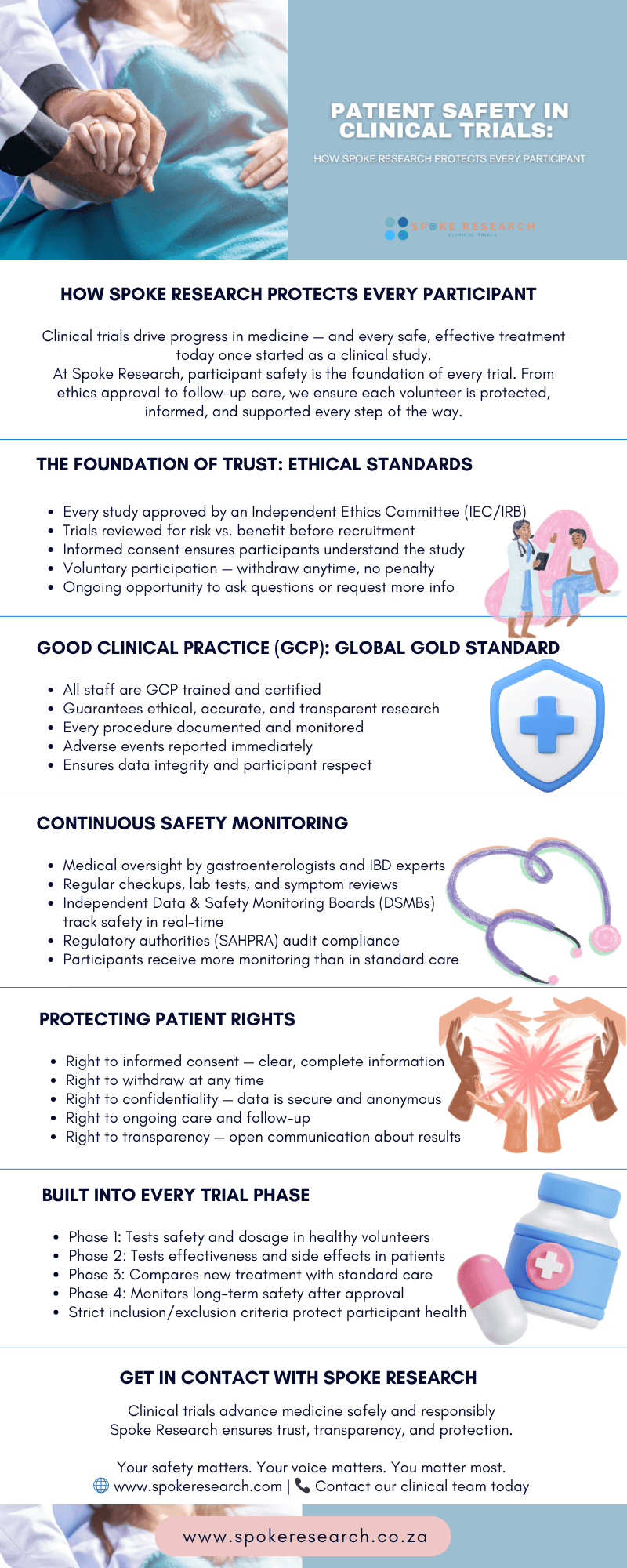
1. The Foundation of Trust: Ethical Standards in Clinical Research
Before a clinical trial can begin, it must undergo a rigorous ethical and regulatory review process. These measures are in place to protect human participants and ensure that every aspect of the study — from recruitment to reporting — meets the highest safety standards.
At Spoke Research, all clinical studies are approved by an Independent Ethics Committee (IEC) or Institutional Review Board (IRB). These independent groups consist of medical professionals, scientists, and community representatives who review the trial design to ensure:
- The potential benefits outweigh the risks.
- Participant rights, safety, and welfare are fully protected.
- The study follows local and international ethical guidelines, including the Declaration of Helsinki and Good Clinical Practice (GCP) standards.
Only once these bodies approve the trial can participant recruitment begin. This ensures that no study proceeds without thorough ethical scrutiny.
Furthermore, participants are never treated as test subjects — they are volunteers who must give informed consent before joining. This means they receive complete, understandable information about the study, including its purpose, procedures, risks, benefits, and their rights.
Informed consent is not a one-time event; it’s an ongoing process. At any point, participants can ask questions, request additional details, or decide to withdraw from the trial without any penalty or impact on their standard medical care.

2. Good Clinical Practice: The Gold Standard for Safety and Quality
Clinical trials around the world follow a unified set of ethical and scientific standards known as Good Clinical Practice (GCP). These guidelines are internationally recognized and ensure that studies are conducted ethically, with accurate data and full respect for participants’ rights.
At Spoke Research, every member of our research team — from coordinators to investigators — is trained and certified in GCP. This commitment guarantees that:
- Every procedure is documented and monitored to ensure accuracy and transparency.
- Patient safety is prioritized in all decisions and interactions.
- Adverse events (any health changes or side effects) are reported immediately and handled according to strict protocols.
- Data integrity is maintained, meaning all results are accurate, verifiable, and securely stored.
GCP is the cornerstone of modern clinical research. It ensures that studies are conducted responsibly, and that participants can trust the integrity of the process.
At Spoke Research, we adhere not just to the letter of these standards, but to their spirit — treating every participant with the compassion and care we would want for our own loved ones.

3. Comprehensive Monitoring and Safety Oversight
One of the greatest misconceptions about clinical trials is that patients are “on their own” once they join. In reality, participants receive more medical attention and monitoring than in standard clinical care.
At Spoke Research, participant safety is continuously monitored through multiple layers of oversight:
A. Medical Monitoring by Experienced Clinicians
Each trial is led by qualified principal investigators — often gastroenterologists and specialists in inflammatory bowel disease (IBD). These doctors closely monitor every participant’s health, reviewing results from blood tests, imaging, colonoscopies, and symptom assessments throughout the study.
Participants typically have regular scheduled visits, during which any side effects, symptoms, or changes are documented and evaluated. This proactive approach helps detect even subtle changes early on, ensuring timely medical intervention if needed.
B. Data and Safety Monitoring Boards (DSMBs)
For larger or higher-risk studies, an independent Data and Safety Monitoring Board reviews ongoing results. This board can pause or stop a trial if any unexpected risks arise or if one treatment proves clearly more beneficial.
C. Regulatory Oversight
In addition to ethics committees, national and international regulatory authorities (such as the South African Health Products Regulatory Authority, SAHPRA) oversee all clinical research activities. These agencies can audit sites at any time to verify compliance and ensure participant safety.
Together, these layers of oversight create a robust safety net — protecting participants from unnecessary risk while ensuring scientific integrity.
4. Protecting Patient Rights: Transparency and Respect
Every participant in a Spoke Research trial has clearly defined rights, protected by law and international ethics codes. These include:
- The right to informed consent — to receive all relevant information and make voluntary decisions.
- The right to withdraw at any time, for any reason, without affecting their ongoing medical care.
- The right to confidentiality, ensuring all personal data is protected and anonymized.
- The right to ongoing medical care and follow-up, even after the trial concludes.
- The right to ask questions and receive clear answers at any stage of the study.
At Spoke Research, we view these rights not as legal obligations, but as moral commitments. Every participant is a partner in discovery, and we ensure they feel respected, heard, and valued throughout the process.
We also believe in transparent communication. Participants are kept informed of their progress, potential side effects, and any new information that arises during the study. Once a trial is completed, results are shared publicly in a responsible and ethical manner — because research should benefit everyone.

5. Minimizing Risk: How Safety Is Built into Every Trial Design
Before a clinical trial begins, researchers perform extensive preclinical studies to understand the potential effects of a new therapy. Only when data from laboratory and early human studies show a favorable safety profile does the treatment move into advanced clinical trials.
Trials are conducted in phases, each with specific goals and safeguards:
- Phase 1: Tests a new therapy for the first time in healthy Volunteers, usually in a small group, to assess safety and dosage.
- Phase 2: Focuses on how well the drug works in the target disease population and continues to monitor safety in a small patient population.
- Phase 3: Compares the new treatment to existing standard care in large trials, consisting of in hundreds or thousands of participants.
- Phase 4: Conducted after approval to monitor long-term safety and effectiveness, or head-to-head studies.
At every phase, participant safety is the top priority. Trials are designed to minimize risk, and patients are closely observed to ensure any side effects are managed promptly and effectively.
Spoke Research follows strict inclusion and exclusion criteria, ensuring that only eligible participants who meet health and safety requirements are enrolled. This helps reduce the likelihood of adverse reactions and ensures the study population is appropriate for the therapy being tested.
6. The Human Side of Safety: Compassion and Support
Beyond protocols and regulations, patient safety is also about empathy, communication, and trust. Living with Crohn’s disease or ulcerative colitis can already be physically and emotionally demanding. That’s why Spoke Research emphasizes human connection and support as part of our approach.
Our coordinators and healthcare staff ensure that participants always know what to expect — from their first visit to follow-up appointments. We take time to listen to concerns, explain procedures in plain language, and provide the reassurance that someone is always available to help.
Participants also have access to continuous care, meaning their overall health is monitored even beyond the specific treatment being studied. If any unrelated health issue arises, our team ensures they receive appropriate medical attention.
This patient-centered approach builds confidence and helps participants feel safe, supported, and respected throughout the research journey.

7. How Spoke Research Puts Safety First — Every Step of the Way
At Spoke Research, our mission is to advance medical science responsibly — without ever compromising patient well-being. We collaborate with experienced investigators, global sponsors, and regulatory authorities to maintain the highest standards of ethics, safety, and transparency.
Our safety commitment includes:
- Rigorous staff training in Good Clinical Practice.
- Strict adherence to ethical and regulatory requirements.
- Continuous safety monitoring and reporting.
- Secure handling of participant data and confidentiality.
- Personalized medical support and follow-up care.
We believe that progress in medicine must never come at the expense of trust. By prioritizing participant safety, we ensure that every study not only advances science but also strengthens the relationship between researchers, doctors, and patients.
Conclusion: Safety and Science Go Hand in Hand
Clinical trials are the bridge between scientific discovery and real-world healing. But that bridge must be built on a foundation of trust, transparency, and patient safety.
At Spoke Research, we don’t just test new treatments — we care for people. Every participant is a valued partner helping move Crohn’s disease and ulcerative colitis research forward safely and responsibly.
If you’re considering joining a clinical trial, know that your safety, rights, and well-being will always come first. Together, we can turn today’s research into tomorrow’s breakthroughs.
📍 Learn more at: www.spokeresearch.com
📞 Contact our clinical team to find out more about current Crohn’s and ulcerative colitis studies and eligibility.
Your safety matters. Your voice matters. And at Spoke Research — you matter most.
Medical surveys
Future treatments are now one step closer.
Contact us
Spoke Research Inc
Mediclinic Milnerton,
Suite 109
Racecourse Rd, Milnerton
Cape Town
0215518678
Mon – Thurs: 08:00-15:00
Fri: 08:00-12:00
Sat: Closed
info@spokeresearch.co.za