
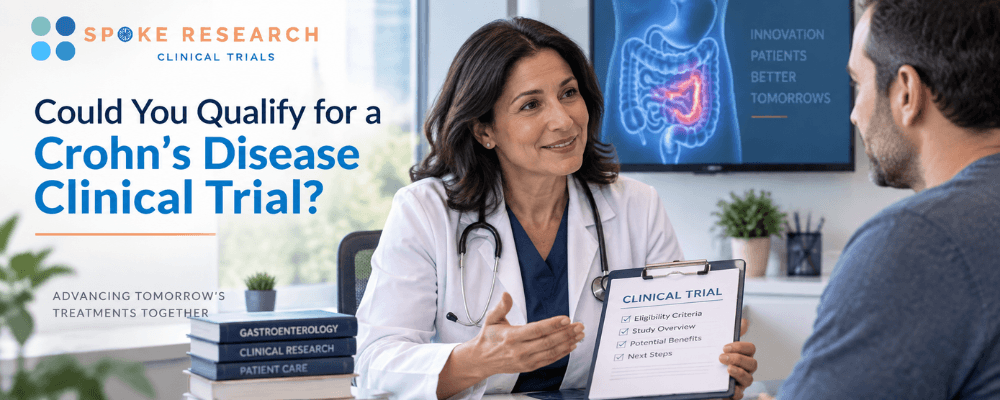
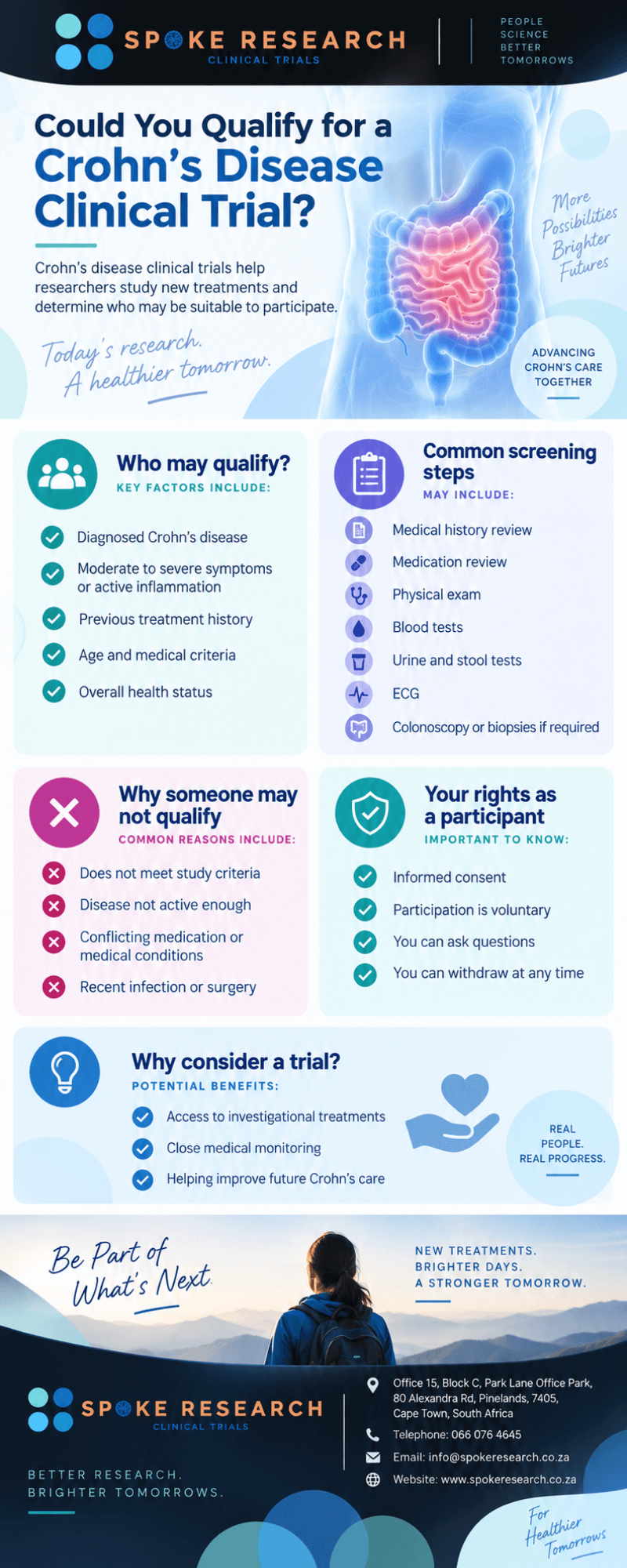
For people living with Crohn’s disease, especially those who continue to experience symptoms despite treatment, clinical trials may provide an opportunity to contribute to research into future therapies. However, joining a study is not automatic. Every trial has specific eligibility criteria designed to protect participants and ensure researchers can answer the scientific questions the study was created to investigate.
Spoke Research specialises in clinical research for inflammatory bowel disease, including Crohn’s disease and ulcerative colitis. The research team guides prospective participants through screening, informed consent, testing and study visits.
Patients can learn more about Spoke Research clinical trials before deciding whether to enquire about a current study.
Why Do Clinical Trials Have Eligibility Criteria?
Every clinical trial follows a detailed research plan known as a protocol. It explains who may participate, which tests and procedures are required, how long participation may last and which outcomes researchers will measure.
Eligibility rules are generally divided into inclusion criteria and exclusion criteria.
Inclusion criteria describe characteristics a participant must have. Exclusion criteria identify factors that may make participation unsuitable or potentially unsafe.
These requirements are not a judgement on the seriousness of a patient’s condition. They help protect participants and ensure the trial produces reliable scientific results.
The National Institutes of Health explains that eligibility criteria may take into account factors such as age, disease type, treatment history and other medical conditions.
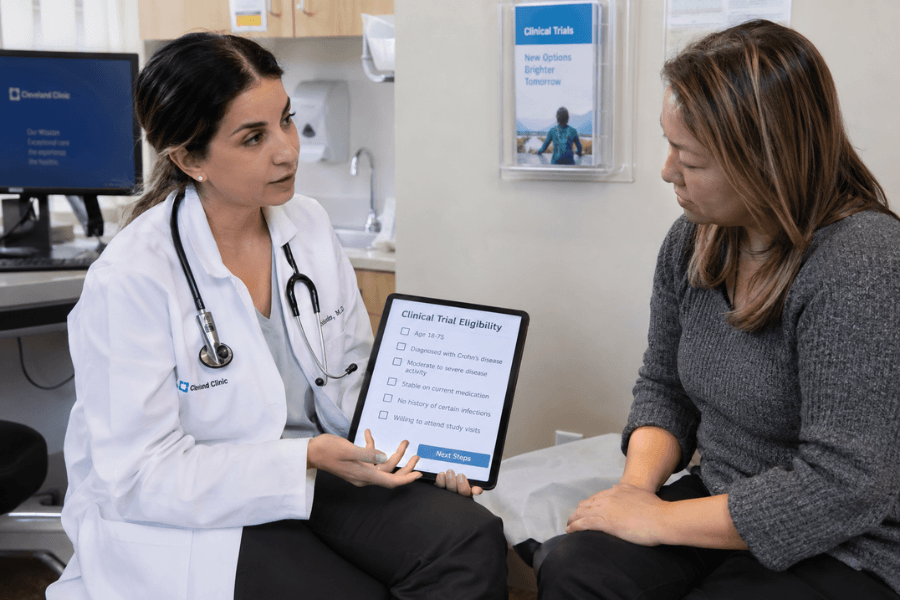
A Confirmed Crohn’s Disease Diagnosis Is Usually Essential
Most Crohn’s disease treatment trials require participants to have a confirmed diagnosis.
Crohn’s disease may cause diarrhoea, abdominal pain, fatigue, weight loss and rectal bleeding, but these symptoms can overlap with other gastrointestinal conditions. Researchers therefore need reliable evidence that Crohn’s disease is present.
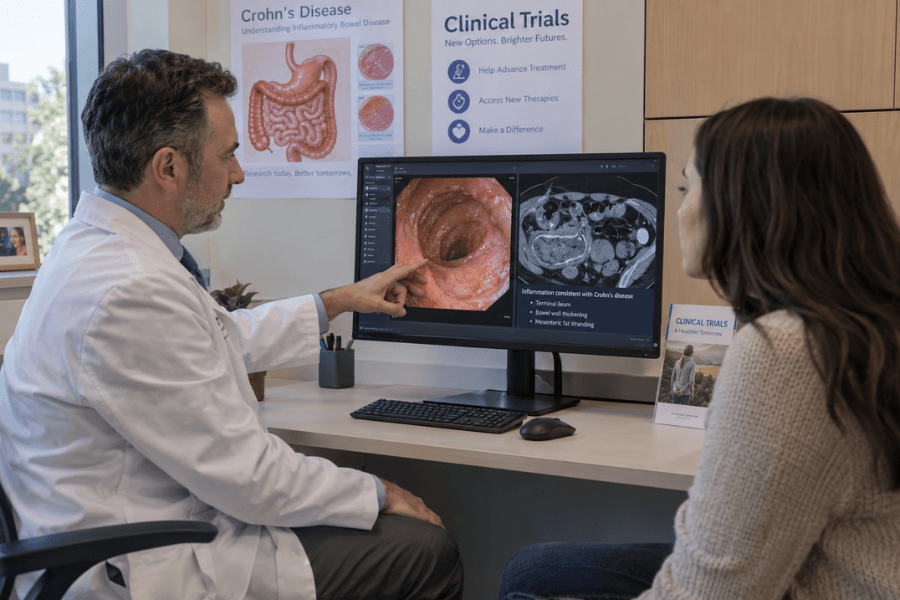
Depending on the study, this may involve reviewing previous colonoscopy reports, biopsy results, imaging and medical records.
The Mayo Clinic explains that Crohn’s disease diagnosis may involve blood tests, stool studies, colonoscopy with biopsies, and imaging. A trial protocol may require repeating some assessments during screening.
Disease Activity Can Affect Eligibility
Having Crohn’s disease does not necessarily mean that a patient will qualify for every Crohn’s clinical trial.
Many treatment studies are designed for people with a particular level of disease activity, such as moderate to severe Crohn’s disease. Researchers may therefore need evidence that inflammation is currently active.
Disease activity may be assessed using:
- Symptoms
- Blood inflammatory markers
- Stool inflammatory markers
- Colonoscopy findings
- Imaging
- Disease-activity scoring systems
A patient whose Crohn’s disease is already well controlled may not meet the criteria for a trial specifically investigating active disease.
In some situations, a complication may require immediate standard medical or surgical care rather than research participation.
This is why eligibility must always be assessed individually.
Previous and Current Treatments Matter
Treatment history is another important part of clinical-trial screening.
Researchers may need to know which Crohn’s medicines you have used, why you stopped them, and whether they worked well enough.
Some trials recruit patients who have not responded sufficiently to certain treatments. Others may exclude previous exposure to therapies that work in a similar way to the investigational medicine.
Current medications are also reviewed carefully. Some may be permitted during the trial, while others may need to remain at a stable dose or be stopped according to the study protocol.
Patients can view information about Spoke Research studies to learn more about the organisation’s IBD research.

Overall Health and Safety Considerations
Eligibility is not based only on Crohn’s disease.
Researchers also need to understand the participant’s general health because another medical condition could affect the safety of an investigational treatment or make study results more difficult to interpret.
Screening may therefore include questions about:
- Current or recent infections
- Previous surgery
- Liver or kidney problems
- Cardiovascular conditions
- Other immune-related diseases
- Previous treatments
- Allergies
- Other medications
What Happens During Clinical-Trial Screening?
If initial information suggests that someone may be suitable for a study, the next step is formal screening.
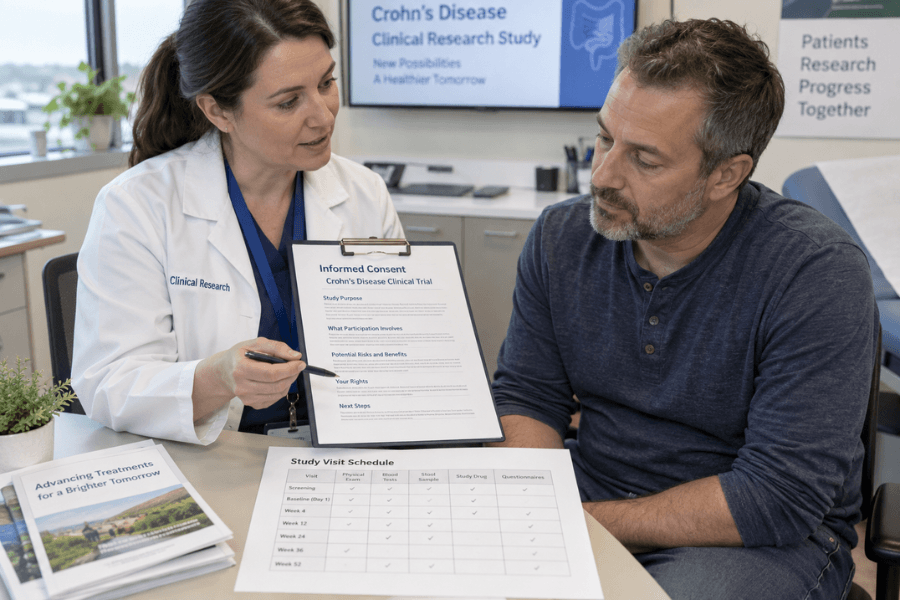
Before study-specific procedures are carried out, prospective participants go through informed consent.
The research team explains the study purpose, expected duration, required procedures, possible risks, potential benefits and alternatives.
Patients should have an opportunity to ask questions before deciding whether to participate.
Participation remains voluntary. NIH guidance emphasises that informed consent is an ongoing process and that participants may withdraw from a study at any time.
Depending on the individual protocol, screening may include:
- Review of medical and treatment history
- Physical examination
- Blood tests
- Urine testing
- Stool tests
- Vital signs
- ECG, if required
- Colonoscopy and biopsies, where required
- Imaging
- Assessment of symptoms and disease activity
The exact screening process differs between clinical trials.
Why Blood and Stool Tests Matter
Blood and stool tests provide objective information about disease activity and general health.
Blood testing may assess anemia, inflammatory markers and organ function. Tests may also be used to screen for infections or other health concerns relevant to the investigational treatment.
Stool testing can help exclude gastrointestinal infections and may measure faecal calprotectin, a marker associated with intestinal inflammation.
These tests help researchers build a clearer picture of what is happening inside the body rather than relying only on symptoms.
Why Might a Colonoscopy Be Required?
Some Crohn’s disease trials require a colonoscopy during screening or at specific stages of the study.
Colonoscopy allows researchers to assess intestinal inflammation directly and, where appropriate, collect small tissue samples called biopsies.
It may also provide an important baseline measurement that researchers can compare with later findings.
This helps determine whether an investigational treatment is associated with improvement in intestinal inflammation, rather than simply reducing symptoms.
A colonoscopy is not required in every clinical trial. The research team should explain all required procedures before a patient agrees to participate.
What Happens If You Don’t Qualify?
Being told that you do not qualify can be disappointing, particularly if you were hoping for another treatment option.
Someone may not qualify because:
- Disease activity falls outside the required range
- A laboratory result does not meet the protocol
- Previous treatment history differs from study requirements
- A medication conflicts with the research protocol
- Another health factor makes participation unsuitable
Clinical-trial criteria are deliberately specific. Their purpose is to protect participants and produce scientifically meaningful results.
Not qualifying for one trial does not mean you will never qualify for another. Different studies investigate different medicines, disease severities and patient populations.
Prospective patients can complete the Spoke Research medical survey to provide information that may help the research team determine whether a current or future study may be relevant.
Potential Benefits and Important Limitations
Eligible participants may have access to an investigational treatment before it becomes generally available and may receive regular assessments from a dedicated research team.
Participation also contributes to medical knowledge that may help improve future Crohn’s disease treatment.
The National Institute of Diabetes and Digestive and Kidney Diseases notes that Crohn’s research includes investigation into new treatments, inflammation, the immune system, genetics and the gut microbiome.
However, benefit is never guaranteed.
An investigational therapy may not work for an individual participant and may cause side effects. Participation may also involve additional appointments, blood tests, stool samples, colonoscopies or other procedures.
Patients should understand both the possible benefits and the practical demands before enrolling.
Questions to Ask Before Joining
Before agreeing to participate, consider asking:
- What is the purpose of this study?
- Why might I qualify?
- What treatment is being investigated?
- What are the possible risks and benefits?
- Could I receive a placebo or comparison treatment?
- How often will I need to attend appointments?
- Which tests and procedures are required?
- Can I continue my usual medication?
- What happens if my Crohn’s disease worsens?
- Can I leave the study if I change my mind?
A clinical research team should welcome questions and help patients understand what participation involves before they make a decision.
Exploring Crohn’s Disease Research at Spoke Research
Spoke Research conducts inflammatory bowel disease research involving Crohn’s disease and ulcerative colitis.
Prospective participants can learn about research opportunities, complete a medical survey, and speak with the research team about possible eligibility.
Patients can also learn more about the clinicians and research professionals involved through the About Spoke Research page.
Conclusion: Could a Crohn’s Disease Clinical Trial Be Right for You?
The only way to know whether you qualify for a specific Crohn’s disease clinical trial is to be assessed against that individual study’s eligibility criteria.
Diagnosis, current disease activity, previous treatment, medication use, laboratory results, overall health and ability to attend study visits may all influence eligibility.
For some people living with Crohn’s disease, clinical research may offer an opportunity to explore an investigational treatment while contributing to knowledge that could improve care in the future.
For others, a particular clinical trial may not be appropriate—and that is an important part of safe, responsible research.
If you are interested in Crohn’s disease research, speak with your healthcare provider and contact Spoke Research to learn about current opportunities and whether an initial eligibility assessment may be suitable.
Contact Spoke Research
Telephone: 066 076 4645
Email: info@spokeresearch.co.za
Website: www.spokeresearch.co.za
Medical surveys
Future treatments are now one step closer.
Contact us
Spoke Research Inc
Mediclinic Milnerton,
Suite 109
Racecourse Rd, Milnerton
Cape Town
0215518678
Mon – Thurs: 08:00-15:00
Fri: 08:00-12:00
Sat: Closed
info@spokeresearch.co.za